The Chariot
The Chariot is the central allegorical vehicle in Dante's Earthly Paradise, a triumphal car drawn by a Griffin that appears in the pageant of the Church Triumphant and becomes the focal point of a series of symbolic transformations, assaults, and corruptions that dramatize the historical degradation of the Church.
Appearance and Composition
The Chariot is a triumphal car on two wheels, drawn by a Griffin whose body is part gold, part white and vermilion, and whose wings rise so high between the middle and outer bands of the procession that they are lost to sight. The car is accompanied by three dancing maidens at the right wheel—one red as fire, one emerald, one white as snow—and four maidens in purple on the left, one of whom has three eyes. Behind the car come two old men, then four of humble aspect, and finally an aged man walking in sleep with a sharp countenance. The Griffin draws the Chariot to a stop opposite Dante, and the entire procession halts.
The Pageant and the Appearance of Beatrice
When the Chariot halts, one of the elders sings "Veni, sponsa, de Libano" three times, and a hundred ministers and messengers of eternal life rise upon the car. They scatter flowers, and within this cloud of blossoms appears a lady under a green mantle, vested in the color of living flame, with a snow-white veil and an olive crown: Beatrice. She addresses Dante directly, rebuking him for his waywardness after her death, and he confesses his fault. The Chariot thus serves as the stage for Beatrice's return and for Dante's purgation.
The Tree of Knowledge and the Binding of the Chariot
After Beatrice's reproach, the procession moves through the forest to a tree despoiled of blooms and leaves—the Tree of Knowledge. The Griffin, praised for not plucking from it, draws the Chariot close and binds its pole to the tree. The tree then renews itself, blossoming with a color less than rose and more than violet. The Chariot is thus tied to the central symbol of humanity's fall and redemption.
The Assaults on the Chariot
While Dante sleeps, the Chariot suffers a series of allegorical attacks. First, an eagle descends through the tree, rending bark, blossoms, and leaves, and strikes the Chariot so that it reels like a vessel in a tempest. Then a fox leaps into the body of the car, but Beatrice drives it away. The eagle descends again, this time leaving its feathers strewn within the Chariot. A voice from heaven cries, "My little bark, how badly art thou freighted!" The earth then yawns between the wheels, and a dragon rises, fixes its tail through the car, and draws out part of the floor. The Chariot, now reclothed with the eagle's feathers, sprouts heads: three on the pole, horned like oxen, and one at each corner with a single horn. Upon this monstrous form sits a shameless whore with roving eyes, and beside her stands a giant who kisses her; when she turns her wanton gaze on Dante, the giant scourges her, then looses the monster and drags it away through the forest, using it as a shield.
Symbolic Meaning and Significance
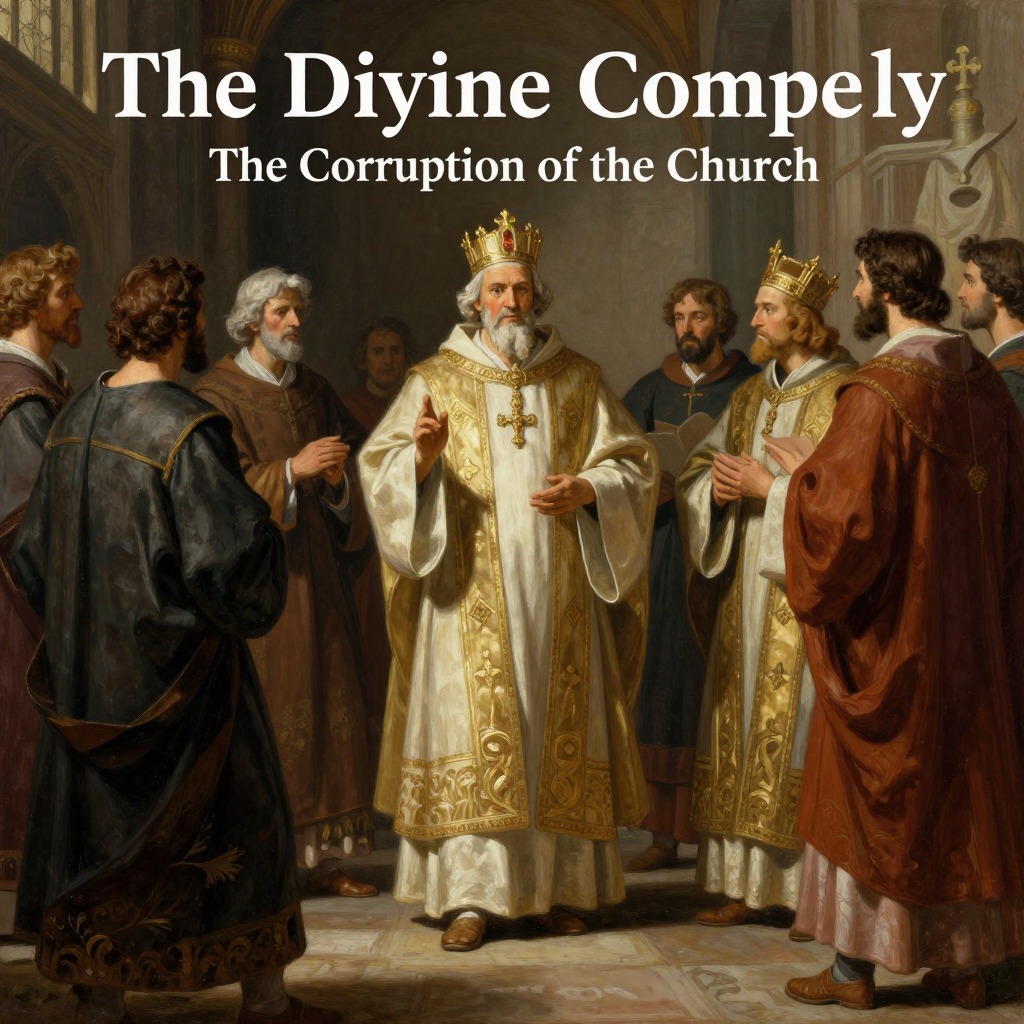
The Chariot represents the Church on earth, and its successive corruptions—by imperial power (the eagle), by heresy (the fox), by the Donation of Constantine (the eagle's feathers), by the schism of the Franciscan Spirituals (the dragon), and by the union of the papacy with the French monarchy (the whore and the giant)—enact the historical decline that Dante laments throughout the poem. The Chariot's transformation from a triumphal vehicle into a monstrous idol mirrors the corruption of the Church from its apostolic purity into a worldly institution. Beatrice's prophecy that a "Five-hundred, Ten, and Five" will slay the thievish woman and the giant points to a hoped-for deliverance. The Chariot thus functions as the central allegorical object in the Earthly Paradise, condensing Dante's critique of ecclesiastical history into a single, evolving symbol.